Home / Guides / Rules and fines
Following Distance in Turkey: The Metre Rule by Speed
Updated 13 November 2026 · 7 min read · testcim editorial team
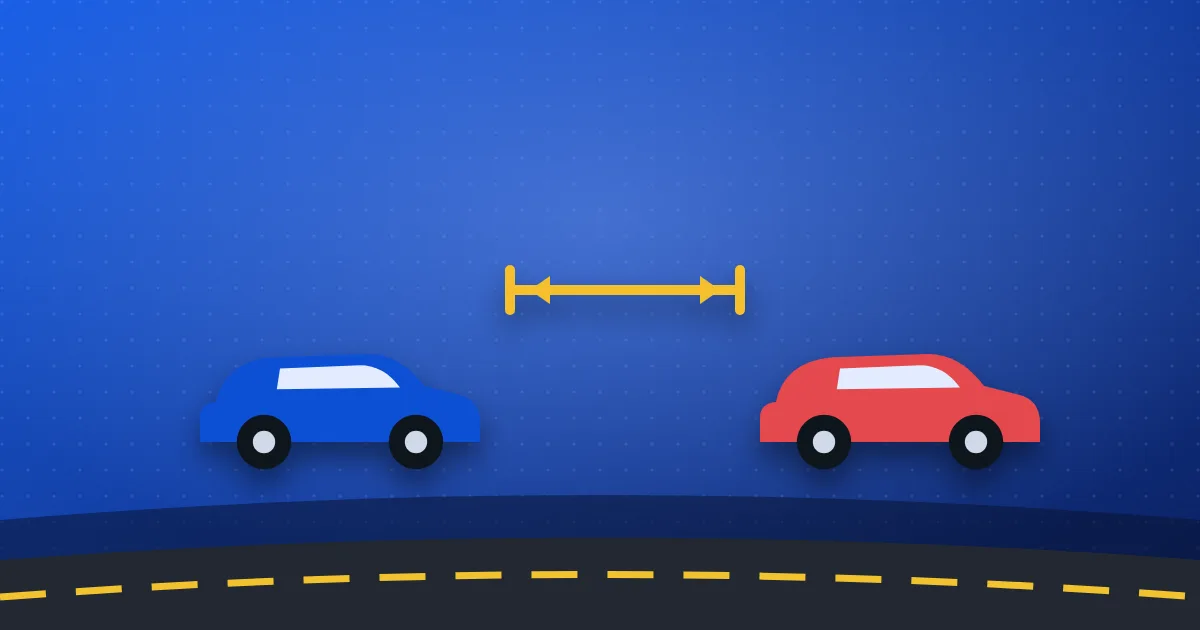
Following distance in Turkey, under the Highway Traffic Regulation (Karayolları Trafik Yönetmeliği), is at least half your speed in km/h in metres: at 80 km/h you leave at least 40 metres. The regulation says this distance can also be the road covered in 2 seconds. If the road is wet, icy or foggy, you need to increase the gap.
What Is Following Distance in Turkey and What Is Its Legal Basis?
Following distance is the safe and sufficient gap you must leave to the vehicle in front, and the law regulates it by banning tailgating.
Article 56 of Highway Traffic Law No. 2918 (Karayolları Trafik Kanunu) requires drivers to follow the vehicles in front at a safe and sufficient distance. In the traffic administrative fines guide of the General Directorate of Security (EGM), this violation appears as "tailgating" under paragraph 56/1-c. Article 107 of the Highway Traffic Regulation is titled "Distance between vehicles" and sets the distance with numbers. According to the article, the following distance is at least half of the vehicle's speed in km/h in metres, or it can be the road the vehicle covers in 2 seconds. The same article requires vehicles travelling in a convoy to leave a gap between them that is large enough for overtaking vehicles to enter safely. Vehicles carrying dangerous goods follow other vehicles at least 50 metres behind on roads outside built-up areas. The driving course programme of the Ministry of National Education (MEB) teaches following distance in the same unit as the speed rules. You can try the theory questions on this subject in the traffic questions test.
How Is Following Distance Calculated?
Under the regulation, following distance is at least half your speed in km/h in metres; the road covered in 2 seconds can also be used.
The calculation is easy: halve the value on the speedometer and leave that many metres. At 80 km/h that is 40 metres, and at 100 km/h it is 50 metres. The second measure in the regulation is 2 seconds, which gives a slightly longer distance at these speeds. At 80 km/h the road covered in 2 seconds is about 44 metres, and at 100 km/h about 56 metres. Because it is hard to measure metres on the road, counting 2 seconds is more practical. Choose a fixed point at the roadside and count two seconds after the vehicle in front passes it; if you reach the same point before you finish counting, you are too close. As speed increases, stopping distance grows, so the gap also grows with speed. To remember the speed limits, you can look at the speed limits page, and for passing the vehicle ahead, the overtaking rules.
- Look at the value on the speedometer.
- Halve the value; leave that many metres.
- Choose a fixed point at the roadside and count two seconds after the vehicle in front passes it.
- If you reach that point before the count ends, drop back.
Get ready to pass first time
Premium gives you everything you need to walk into the exam confident:
- All of our 1,000+ questions in English, with explanations
- Full mock exams: 50 questions, 45 minutes, just like the real thing
- Practise by subject and focus on your weak spots
- Mistakes notebook, progress chart and no ads
One-time payment: 249.90 TL · valid for 1 year. A resit costs 1,250 TL.
How Many Metres of Following Distance Should I Leave at Each Speed?
Under the half-the-speed rule, the minimum distance is 25 metres at 50 km/h, 40 metres at 80 km/h, 50 metres at 100 km/h and 60 metres at 120 km/h.
The table below is calculated with the half-the-speed rule in the regulation; we have also added the 2-second distance next to it. These are minimum values for a dry, straight road. As road conditions get worse, you should leave a larger gap even at the same speed. Do not confuse the speeds in the table with the speed limit valid on that road; the limit is determined by the signs and the type of road. For the limits, the speed limit sign page will help. The braking performance of your own vehicle is also important. A vehicle with old tyres or a heavy load needs a longer distance to stop. So take the numbers in the table as a floor and always leave a little more. For the sign about following distance, you can look at the minimum distance sign page.
Minimum following distance under the half-the-speed rule
| Speed (km/h) | Minimum distance (half the speed, m) | Distance in 2 seconds (approx., m) |
|---|---|---|
| 50 | 25 | 28 |
| 80 | 40 | 44 |
| 100 | 50 | 56 |
| 120 | 60 | 67 |
How Much Following Distance Should I Leave on Wet, Icy and Foggy Roads?
In conditions such as rain, snow, ice and fog, you need to increase the following distance above the minimum in the regulation.
The half-the-speed rule in the regulation is a lower limit, that is, it gives the least distance you must leave. The lesson programme of the Ministry of National Education (MEB) lists adjusting following distance to road, weather and load conditions as a learning outcome. On a slippery surface the grip of the tyres falls and stopping distance gets longer, so more gap is needed at the same speed. In fog and rain your visibility also shortens, which narrows your reaction time. If you are carrying a heavy load and are on a downhill road, you are also expected to increase the gap. If you are travelling in a convoy, vehicles leave enough space for overtaking vehicles to enter between them safely. In winter conditions, lowering your speed is as important as increasing the distance. For the slippery road warning, you can look at the slippery road sign page.
Distance by condition
| Condition | What should you do? |
|---|---|
| Dry, straight road | At least half the speed in metres, or 2 seconds |
| Rain, snow, ice, fog | Increase the distance and reduce your speed |
| Heavy load, downhill | Increase the distance |
| Convoy | Leave enough space for an overtaking vehicle to enter |
| Vehicle carrying dangerous goods (outside built-up areas) | At least 50 metres |
What Happens If I Do Not Keep the Following Distance?
If you do not leave enough distance, the tailgating violation is committed and an administrative sanction arises under paragraph 1(c) of Article 56 of the law.
The EGM penalty guide lists not following the vehicles in front at a safe and sufficient distance under paragraph 56/1-c. We do not write the amount of the fine here because it is updated every year with the revaluation rate. You can find the current amount on the traffic fines page. We explain the subject of penalty points in the penalty points article. The real risk is not the fine but a rear-end collision. If the vehicle in front brakes suddenly and your reaction time is not enough, you collide. For this reason, following distance is both a rule and a matter of safety. If you are preparing for the exam, repeat the topic within the study plan. You can read the text of the law on the Highway Traffic Law page.
- Violation in the law: Article 56/1-c, tailgating.
- Fine amount: current on the traffic fines page.
- Penalty points: on the penalty points page.
FAQ
How many metres should the following distance be?
As a practical rule, you should leave half your speed in metres: 40 metres at 80 km/h and 50 metres at 100 km/h. You need to increase this distance when the road is slippery.
What is the two-second rule?
Under the regulation, the following distance can also be the road your vehicle covers in 2 seconds. Count two seconds after the vehicle in front passes a fixed point; if you reach that point before the count ends, you are too close.
Under which article is the tailgating penalty?
Tailgating is in paragraph (c) of the 1st subsection of Article 56 of Law No. 2918. For the current amount of the fine, see the traffic fines page.
How is following distance asked in the exam?
The exam generally asks about the half-the-speed rule and increasing the distance when conditions get worse. It also helps to know the 2-second measure in the regulation and 50 metres for vehicles carrying dangerous goods.
Sources: Highway Traffic Law No. 2918 (mevzuat.gov.tr) · Highway Traffic Regulation (mevzuat.gov.tr) · EGM Traffic Administrative Fines Guide · MEB Traffic and Environment Lesson Programme. Rules and fees can change; check the official sources for the latest information.