Home / Practice test / Vehicle technology questions
Vehicle technology questions for the Turkish driving test
Last updated: 28 October 2026 · 29 free questions
9 of the 50 questions (18 points) in the Turkish driving licence e-exam come from Engine and Vehicle Technology. It looks small, but it is where many candidates lose points because of the technical terms. Answer the questions below: when you pick an option you see the correct answer and the explanation straight away.
Dashboard and warning light questions
In short: A red warning light means a serious problem: if the oil pressure, temperature or brake light comes on, stop in a safe place and switch off the engine. Amber lights need a check soon; green and blue lights are for information.
Related: Vehicle technology notes
Question 1
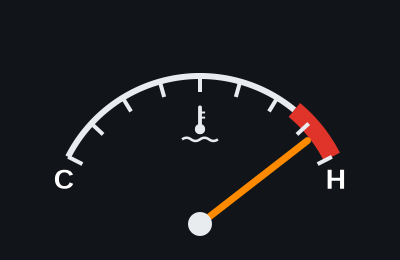
While driving, the needle of the engine temperature gauge shown has risen into the red zone. What is the correct action?
Show answer and explanation
Correct answer: A) Stop somewhere safe and let the engine cool down
A needle in the red zone means the engine is overheating; driving on can damage the cylinder head and gasket. Stop in a safe place and check the coolant once the engine has cooled. Opening the cap on a hot engine releases boiling coolant under pressure and can cause burns; the air conditioning adds extra load to the engine.
Question 2
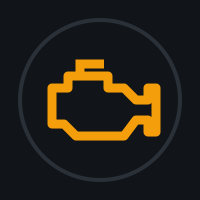
While driving, the engine malfunction light starts flashing instead of staying on steadily, as in the animation. Which statement is correct?
Show answer and explanation
Correct answer: D) There may be a serious misfire; get it repaired at once
A steady engine malfunction light points to a fault needing a check soon, while a flashing light indicates a serious problem such as misfiring. Unburnt fuel can damage the catalytic converter in the exhaust, so high speeds and heavy loads should be avoided and the car repaired without delay.
Question 3
While driving, the red warning light shown comes on. What should the driver do?
Show answer and explanation
Correct answer: B) Stop in a safe place and switch off the engine
This is the oil pressure warning light. Driving on with low oil pressure seriously damages the engine. Stop safely and switch off the engine.
Question 4
If the warning light shown stays on while the engine is running, what does it mean?
Show answer and explanation
Correct answer: B) The charging system is not charging the battery
This is the battery (charging) warning light. If it is on with the engine running, the alternator may not be charging the battery, often because of the alternator belt or the alternator itself.
Question 5
What does the warning light shown mean?
Show answer and explanation
Correct answer: B) The engine is overheating
This is the coolant temperature warning light: the engine is overheating. Stop safely, and never open the radiator cap while the engine is hot.
Question 6
The red light shown is on even though the handbrake is released. What could this mean?
Show answer and explanation
Correct answer: A) Brake fluid is low
The brake warning light comes on when the handbrake is applied. If it stays on with the handbrake released, brake fluid is low or there is a fault in the braking system.
Question 7
The light shown is on and a vehicle is approaching from the opposite direction. What should you do?
Show answer and explanation
Correct answer: C) Switch to low beam
High beam dazzles the oncoming driver. Switch to low beam when a vehicle approaches.
Engine, cooling and lubrication questions
In short: The four strokes of an engine are intake, compression, power and exhaust. Check the engine oil with the dipstick when the car is on level ground and the engine is off; the level should be between the low and high marks.
Related: Vehicle technology notes
Question 8
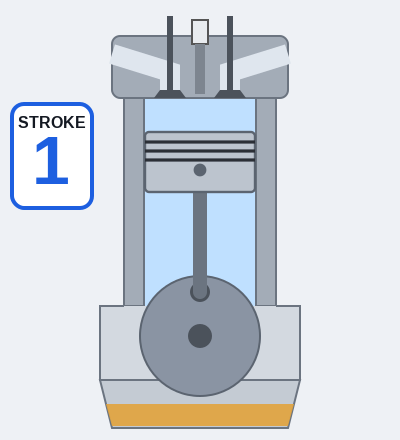
The animation shows one cycle of a four-stroke engine as strokes 1, 2, 3 and 4 in order. In which stroke does the burning mixture push the piston down and deliver power to the crankshaft?
Show answer and explanation
Correct answer: C) Stroke 3
The four strokes are intake (1), compression (2), power/combustion (3) and exhaust (4). When the compressed mixture ignites, the expanding gases push the piston down; this is the only stroke that produces power. In the other three strokes the piston is moved by energy stored in the flywheel.
Question 9
How should the engine oil level be checked?
Show answer and explanation
Correct answer: C) With the engine off and the car on level ground
For an accurate reading, switch off the engine, park on level ground and check with the dipstick.
Question 10
What is the most likely cause of an engine overheating?
Show answer and explanation
Correct answer: B) Low coolant in the radiator
Low coolant, or a faulty thermostat or fan, makes the engine overheat.
Question 11
What is the correct order of the strokes in a four-stroke engine?
Show answer and explanation
Correct answer: B) Intake - compression - power - exhaust
A four-stroke engine works in the order intake, compression, power (combustion) and exhaust.
Question 12
Why is it dangerous to open the radiator cap when the engine is hot?
Show answer and explanation
Correct answer: B) Pressurised boiling water and steam can spray out and cause burns
When the engine is hot the cooling system is under pressure. Opening the cap can release boiling water and steam and cause serious burns.
Question 13
What is the job of the valves in an engine?
Show answer and explanation
Correct answer: B) To control what enters the combustion chamber and let exhaust gases out
The intake valve controls the entry of the mixture (air in a diesel), and the exhaust valve lets burnt gases out.
Question 14
What does the radiator do?
Show answer and explanation
Correct answer: D) Cools the hot coolant coming from the engine
The radiator cools the hot water from the engine by passing its heat to the air flowing through it.
Question 15
What should you do when you first start a cold engine?
Show answer and explanation
Correct answer: B) Avoid high revs and heavy loads until the engine warms up
In a cold engine the oil has not yet reached every part, so do not strain it until it warms up.
Question 16
When checking with the dipstick, where should the engine oil level be?
Show answer and explanation
Correct answer: C) Between the lower and upper marks
The oil level should be between the min and max marks. Too little and too much are both harmful.
Brakes, tyres, transmission and safety system questions
In short: ABS stops the wheels locking under hard braking, so you can still steer while braking. Snow chains go on the driven wheels, the ones that transmit engine power to the road.
Question 17
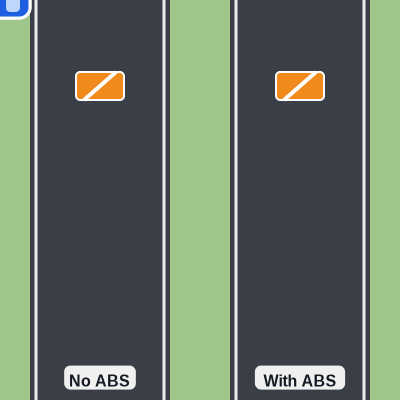
In the animation, on a wet road, red car 1 (without ABS) and blue car 2 (with ABS) brake hard at the same moment for an obstacle ahead. What is the most important benefit ABS provides here?
Show answer and explanation
Correct answer: D) The driver can still steer while braking
Because ABS prevents the wheels from locking, the tyres keep rolling and the driver can steer around the obstacle even under hard braking. The car with locked wheels (1) slides straight ahead without responding to the steering. ABS does not shorten the stopping distance on every surface, and it has nothing to do with pedal effort or pad life.
Question 18
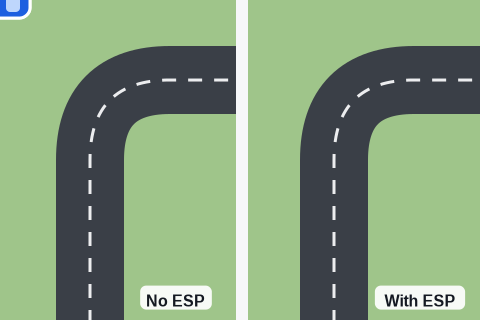
In the animation, red car 1 (without ESP) skids off the road in the bend while blue car 2 (with ESP) stays on course. How does ESP achieve this?
Show answer and explanation
Correct answer: A) By braking individual wheels and reducing engine power
ESP uses sensors measuring steering angle, wheel speeds and the car's rotation about its vertical axis to compare where the driver wants to go with where the car is actually going. When they differ, it brakes individual wheels and, if necessary, cuts engine power to keep the car on course. It cannot overcome physics; at excessive speed it too is insufficient.
Question 19
Under the 2025 amendment to the winter tyre communiqué, what period does the winter tyre requirement cover for vehicles carrying passengers and goods on intercity roads?
Show answer and explanation
Correct answer: B) 15 November - 15 April
The amendment of 4 October 2025 replaced the former 1 December-1 April period with a five-month period from 15 November to 15 April of the following year. Provincial governorships may extend it by one month before and/or after, depending on local climate (Winter Tyre Communiqué, Art. 5).
Question 20
What is the main job of the ABS braking system?
Show answer and explanation
Correct answer: B) To stop the wheels locking under sudden braking
ABS stops the wheels locking when you brake hard, so you can still steer while braking.
3 more questions in this section. Premium members see these questions with the correct answers and explanations. If you are a Premium member, log in and the questions will open here.
Electrics, fuel and maintenance questions
In short: While the engine runs, the alternator charges the battery. A fuse protects the electrical system by cutting the circuit when the current is too high.
All 6 questions in this section are Premium. Premium members see these questions with the correct answers and explanations. If you are a Premium member, log in and the questions will open here.
Practise every Vehicle Technology question
The questions on this page are free samples. Premium unlocks over 1,000 questions in English with explanations, a different 50-question mock exam every time, practice by subject and a mistakes notebook.
One-time payment: 249,90 TL · valid for 1 year.
What does Vehicle Technology cover?
These questions usually come from how the engine works, the cooling and lubrication systems, fuel and ignition, brakes and steering, tyres, dashboard warning lights and routine maintenance. Read the vehicle technology study notes first, then come back and answer the questions again.
Frequently asked questions
How many vehicle technology questions are in the Turkish driving test?
There are 9 questions from Engine and Vehicle Technology, worth 18 points.
Why do candidates find this subject hard?
Terms such as radiator, thermostat and alternator are not used much in everyday life. Learning each term together with its job makes it easier.
Source: MEB MTSK e-Exam Guide 2026 (number of questions, time, pass mark and subject split). The question pool contains past exam questions published by MEB and original questions written to the MEB curriculum, translated into English.