Home / Practice test / Traffic etiquette questions
Traffic etiquette questions for the Turkish driving test
Last updated: 28 October 2026 · 20 free questions
6 of the 50 questions (12 points) in the Turkish driving licence e-exam come from Traffic Etiquette (trafik adabı). Most can be solved with common sense, but the options are close, so read them carefully. When you pick an option you see the correct answer and the explanation straight away.
Communication, respect and anger control in traffic
In short: Traffic etiquette questions are about respect, empathy, patience and communication. The option that protects others, calms the situation and follows the rules is usually the right one.
Question 1
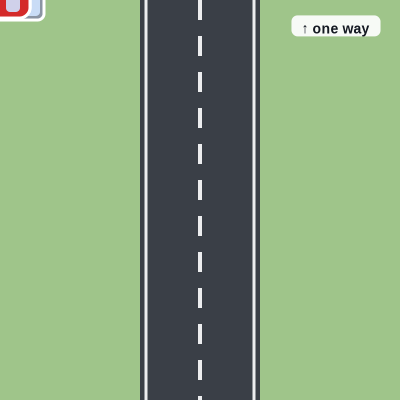
In the picture, on a one-way road, green car no. 2 is overtaking lorry no. 3 in the left lane. Red car no. 1 comes right up behind no. 2 and flashes its headlights repeatedly. Which statement about car no. 1 is correct?
Show answer and explanation
Correct answer: A) It is putting pressure on a driver trying to complete an overtake, creating danger
Car no. 2 must finish overtaking and then return to the right lane; tailgating and repeated flashing put it under stress and raise the risk of mistakes and a crash. Flashing is for a brief warning, not a means of harassment; car no. 1 should keep a safe distance and wait for no. 2 to move back.
Question 2
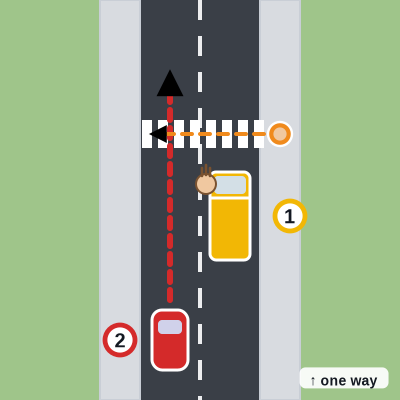
On the one-way, two-lane road in the picture, yellow van no. 1 has stopped before the zebra crossing and its driver waves the pedestrian across. What is the main drawback of this behaviour?
Show answer and explanation
Correct answer: B) It gives the pedestrian a false sense that car no. 2 will also stop
Giving pedestrians priority at a zebra crossing is correct, but a driver can only decide for their own vehicle. The van blocks the view, so driver no. 2 may see the pedestrian late; the hand signal can lead the pedestrian into danger. It is enough to stop and let the pedestrian check and cross on their own.
Question 3
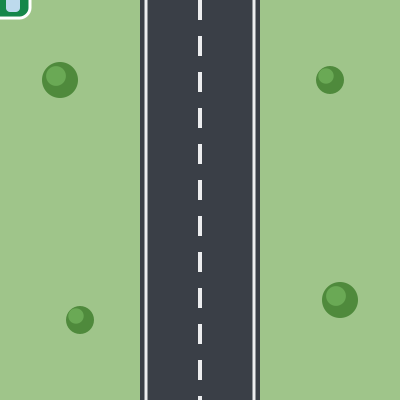
In the picture, green car no. 1 is weaving within its lane. The driver notices that they keep yawning and cannot remember the last few kilometres. What is the most appropriate behaviour?
Show answer and explanation
Correct answer: D) Stop at the first safe rest area and sleep or rest
Weaving, frequent yawning and not remembering the last kilometres are signs of serious fatigue and microsleep. Coffee, fresh air or loud music only help briefly; the driver must stop at the first safe place and rest or sleep.
Question 4
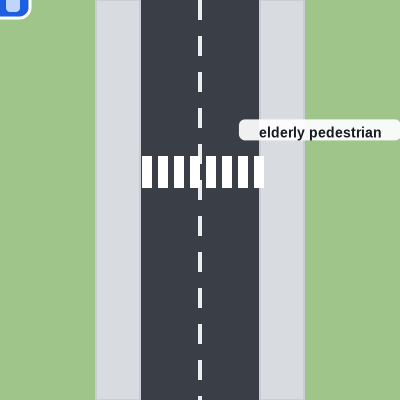
In the picture, blue car no. 1 has stopped at the zebra crossing and an elderly pedestrian has started to cross. As soon as the pedestrian has crossed its lane, car no. 1 moves off. Which statement about this behaviour is correct?
Show answer and explanation
Correct answer: B) Moving off before the pedestrian reaches the other side unsettles them; it should have waited
Drivers must give pedestrians priority at zebra crossings (Traffic Law Art. 74). Elderly people walk slowly, and a vehicle moving close by can frighten them, make them lose balance or turn back. The courteous behaviour is to wait until the pedestrian has fully reached the other side.
Question 5
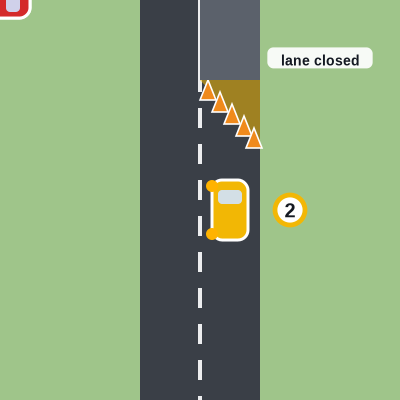
In the picture, the right lane is closed ahead. While yellow car no. 2 waits with its indicator on to move into the left lane, red car no. 1 speeds up and closes the gap to car no. 3 in front. Which statement about car no. 1 is correct?
Show answer and explanation
Correct answer: C) By closing the gap it made merging harder and increased the risk by shortening its following distance
A driver changing lanes must check it is safe, but courtesy and tolerance mean letting the car from the closing lane merge in turn by adjusting speed and gap. Speeding up to close the gap also shortens the following distance and increases congestion and the risk of a crash.
Question 6
In traffic, the 'principle of trust' means that a law-abiding driver may act on the assumption that other road users will also obey the rules. In which of the following situations would relying on this principle be most wrong?
Show answer and explanation
Correct answer: A) Assuming that children chasing each other on the pavement will not run into the road
The principle of trust applies only as long as the other person can be expected to behave correctly. It cannot be relied on with people who clearly may not follow the rules, such as children, distracted pedestrians and the elderly; the driver must slow down and be ready to stop.
Question 7
Angered by a driver who honked at him, a man follows that car for kilometres, then gets out at a red light and walks towards the other driver aggressively. Which statement about this behaviour is correct?
Show answer and explanation
Correct answer: C) It goes against anger control and is also prohibited by law
A provision added to Article 46 of the Traffic Law by Law No. 7574 (2026) prohibits persistently following another vehicle with the aim of attacking, or getting out of the vehicle for that purpose; the driving licence is suspended and the vehicle is taken off the road. The right thing to do when angry is to drive on without escalating the incident.
Question 8
A driver whose eyes are on the road and hands on the wheel is having a heated business call using a hands-free system. What type of distraction does this driver mainly have?
Show answer and explanation
Correct answer: A) Mental (cognitive) distraction
Even with eyes on the road and hands on the wheel, a mind busy with the conversation perceives hazards late; this is called mental (cognitive) distraction. A hands-free system solves the problem of holding the phone but does not remove the mental load.
Question 9
A driver sees a pedestrian waiting to cross at a pedestrian crossing. What should the driver do?
Show answer and explanation
Correct answer: C) Stop and let the pedestrian cross
Pedestrians have priority at crossings. The driver stops so the pedestrian can cross safely.
Question 10
What does showing empathy in traffic mean?
Show answer and explanation
Correct answer: B) Being able to put yourself in other drivers' and pedestrians' shoes
Empathy means seeing things from the other person's point of view. It makes traffic calmer and safer.
Question 11
Which of the following is NOT good traffic etiquette?
Show answer and explanation
Correct answer: B) Driving on the hard shoulder when traffic is jammed
Using the hard shoulder to jump the queue breaks the rules and blocks emergency vehicles such as ambulances.
Question 12
You get into an argument with another driver. What is the best thing to do?
Show answer and explanation
Correct answer: B) Stay calm and continue on your way without prolonging it
Controlling your anger and not escalating keeps you and other road users safe.
Question 13
An ambulance with its siren and lights on is coming up behind you. What is the best thing to do?
Show answer and explanation
Correct answer: B) Move to the right of the road and slow down or stop to let it pass
Give emergency vehicles a safe way through by moving to the right and stopping if needed. Sudden braking is dangerous for vehicles behind you.
Question 14
A driver wants to change lanes. What is the best way to communicate with other road users?
Show answer and explanation
Correct answer: D) Check the mirrors, signal in advance and change lanes safely
A signal tells others your intention in advance. Checking mirrors and signalling before the manoeuvre lets other drivers react.
Question 15
Which of the following shows courtesy in traffic?
Show answer and explanation
Correct answer: A) Thanking a driver who gave way with a wave
Thanking a driver who gave way builds mutual respect and courtesy on the road.
Question 16
It is raining and a pedestrian is crossing slowly at a crossing. Your light turns green. What is the best thing to do?
Show answer and explanation
Correct answer: A) Wait for the pedestrian to finish crossing
Even when your light is green, do not move until pedestrians still on the crossing have finished crossing.
Question 17
On public transport, an elderly, pregnant or disabled passenger is standing. What is the best thing to do?
Show answer and explanation
Correct answer: A) Offer them your seat
Giving your seat to priority passengers is a matter of respect and courtesy.
Question 18
The city bus in front of you has finished at a stop and is signalling to pull out. What is the best thing to do?
Show answer and explanation
Correct answer: D) If it is safe, slow down and let the bus pull out
Making room for public transport helps traffic flow and keeps passengers safe.
Question 19
After a close call caused by another driver, a driver cuts in front of them and brakes suddenly to punish them. Which is true about this behaviour?
Show answer and explanation
Correct answer: B) It is aggressive and dangerous and can cause a rear-end crash
Trying to take revenge in traffic is aggressive driving. Sudden braking causes rear-end crashes.
Question 20
You see a broken-down car on the hard shoulder with people standing next to it. The left lane is free. What is the best thing to do?
Show answer and explanation
Correct answer: C) Slow down and, if safe, move to the left lane to give them more space
People at the roadside are very vulnerable. Slowing down and changing lanes if possible gives them more room and protects them.
Practise every Traffic Etiquette question
The questions on this page are free samples. Premium unlocks over 1,000 questions in English with explanations, a different 50-question mock exam every time, practice by subject and a mistakes notebook.
One-time payment: 249,90 TL · valid for 1 year.
A quick way to answer etiquette questions
Traffic etiquette questions are about respect, patience, empathy, anger control and the rights of pedestrians and other drivers. The option that protects others, calms the situation and follows the rules is usually the right one. Options such as sounding the horn, flashing your lights or arguing "to defend your rights" are almost always wrong.
Frequently asked questions
How many traffic etiquette questions are in the Turkish driving test?
There are 6 Traffic Etiquette questions, worth 12 points.
Are traffic etiquette questions difficult?
It is usually the easiest subject, but the options can be close. Choose the behaviour that protects others and calms the situation.
Source: MEB MTSK e-Exam Guide 2026 (number of questions, time, pass mark and subject split). The question pool contains past exam questions published by MEB and original questions written to the MEB curriculum, translated into English.