Home / Practice test / First aid questions
First aid questions for the Turkish driving test
Last updated: 28 October 2026 · 41 free questions
12 of the 50 questions in the Turkish driving licence e-exam come from First Aid (24 points), and it is one of the subjects where candidates lose the most points. Answer the questions below: when you pick an option you see the correct answer and the explanation straight away.
Accident scene, 112 and body systems questions
In short: The basic steps of first aid are summed up as KBK: Protect, Report, Rescue (Koruma, Bildirme, Kurtarma). The emergency number in Turkey is 112; make yourself and the scene safe first.
Question 1
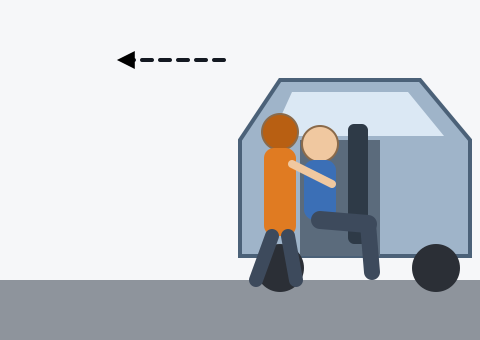
Before starting the vehicle extraction manoeuvre shown in the animation, what must be done?
Show answer and explanation
Correct answer: B) Undo the seat belt and check that the feet are not trapped by the pedals
Before the Rautek manoeuvre, the ignition is switched off, the handbrake applied, the feet checked for entrapment at the pedals and the seat belt undone. The casualty is then gripped from behind and pulled out keeping the head-neck-trunk aligned.
Question 2
Which number do you call for emergency help in Turkey?
Show answer and explanation
Correct answer: C) 112
112 is the emergency number for all emergencies in Turkey.
Question 3
The basic steps of first aid in Turkey are known as "KBK". What do they stand for?
Show answer and explanation
Correct answer: B) Protect, Report, Rescue
KBK stands for Koruma (Protect), Bildirme (Report) and Kurtarma (Rescue).
Question 4
If there is no immediate danger to life, what is correct about removing a casualty from a vehicle?
Show answer and explanation
Correct answer: B) Do not move them until the medical team arrives
If there is no danger such as fire or explosion, do not move the casualty because of the risk of spinal injury. The Rautek manoeuvre is only used when life is in danger.
Question 5
Which statement about first aid is correct?
Show answer and explanation
Correct answer: B) It is help given without medicine until medical staff arrive
First aid is help given without medicine to save a life or stop a condition getting worse until medical help arrives.
Question 6
What is the normal resting pulse rate of a healthy adult, per minute?
Show answer and explanation
Correct answer: C) 60-100
A healthy adult's resting pulse is about 60 to 100 beats per minute.
Question 7
Which organs make up the central nervous system?
Show answer and explanation
Correct answer: A) The brain and spinal cord
The central nervous system consists of the brain and the spinal cord.
Question 8
If brain cells are deprived of oxygen, after about how long does permanent damage begin?
Show answer and explanation
Correct answer: C) 4-6 minutes
The brain is very sensitive to lack of oxygen. Permanent damage can begin within about 4 to 6 minutes.
Basic life support and choking questions
In short: Adult basic life support is 30 chest compressions to 2 rescue breaths, at 100-120 compressions a minute and a depth of 5-6 cm. An unconscious person who is breathing normally is placed in the recovery position.
Question 9
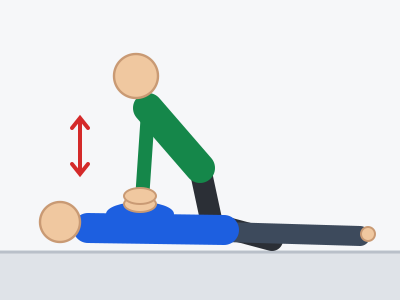
While giving chest compressions to an adult as shown, what should be done after each compression?
Show answer and explanation
Correct answer: B) Let the chest return fully to its normal position
After each compression the chest is allowed to recoil fully; this lets the heart refill with blood. The hands are not lifted or moved, there is no pulse check between compressions and pauses must not exceed 10 seconds (MoH Skills Guide).
Question 10
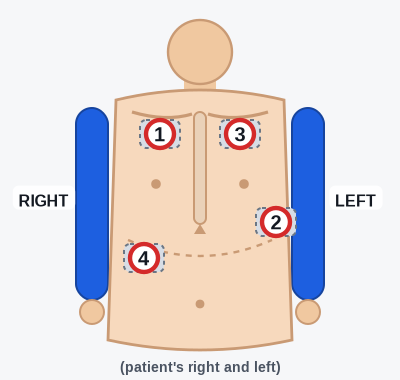
In the figure, where should the pads be placed when using an AED on an adult?
Show answer and explanation
Correct answer: A) 1 and 2
One pad goes below the patient's right collarbone, to the right of the breastbone; the other to the left of the left nipple, on the side above the lower ribs (1 and 2). This way the current passes diagonally through the heart; the pads must not touch each other.
Question 11
A first aider alone with an adult who is unresponsive and not breathing normally needs to call 112. How should he do it?
Show answer and explanation
Correct answer: B) Use the speaker, stay with the patient and follow the call handler's directions
According to the Ministry of Health Skills Guide, a lone first aider calls 112 with the phone on speaker. This way he can stay with the patient, listen to the call handler and start chest compressions without losing time.
Question 12
The airway of an unresponsive adult is opened. The person takes irregular, inadequate gasps at long intervals, like sighs. What should the first aider do?
Show answer and explanation
Correct answer: D) Treat it as absent normal breathing and start basic life support
Occasional, sigh-like irregular gasps (agonal breathing) are not normal breathing and are an early sign of cardiac arrest; basic life support is started at once (ERC 2021). The recovery position is only for an unconscious person who is breathing normally; waiting leads to brain damage.
Question 13
Two first aiders are giving basic life support together to a 5-year-old child who is not breathing. According to first aid training in Türkiye, what should the compression-to-breath ratio be?
Show answer and explanation
Correct answer: B) 15 compressions / 2 breaths
According to the MoH Skills Guide, for children and infants a single first aider uses 30:2 and two or more first aiders use 15:2. ERC guidelines also recommend 15:2 for trained rescuers in children; the exam follows this distinction in the Turkish curriculum.
Question 14
When giving basic life support (CPR) to an adult, what should the ratio of chest compressions to rescue breaths be?
Show answer and explanation
Correct answer: B) 30 compressions / 2 breaths
For adults, give 2 rescue breaths after every 30 chest compressions.
Question 15
Which position should an unconscious casualty who is breathing be placed in?
Show answer and explanation
Correct answer: B) Recovery position
An unconscious person who is breathing is put in the recovery position so the tongue or vomit does not block the airway.
Question 16
In the ABC of first aid, what does the letter "A" stand for?
Show answer and explanation
Correct answer: B) Airway
A is Airway, B is Breathing and C is Circulation.
Question 17
How deep should chest compressions be when giving CPR to an adult?
Show answer and explanation
Correct answer: C) 5-6 cm
For adults, press on the lower half of the breastbone to a depth of at least 5 cm and no more than 6 cm.
Question 18
What should you do for a conscious adult whose airway is completely blocked (choking)?
Show answer and explanation
Correct answer: B) Give back blows and the Heimlich manoeuvre (abdominal thrusts)
For a person who cannot speak or cough, give back blows first, then abdominal thrusts (Heimlich) if that does not work. Never do blind finger sweeps.
Question 19
How can you tell that mouth-to-mouth rescue breathing is working?
Show answer and explanation
Correct answer: B) The chest rises with each breath
If the air reaches the lungs, the chest rises. That shows the breaths are effective.
Question 20
How do you check whether a baby is conscious?
Show answer and explanation
Correct answer: C) Tap the soles of their feet gently and call to them
Check a baby's response by gently tapping the soles of the feet. Never shake a baby.
2 more questions in this section. Premium members see these questions with the correct answers and explanations. If you are a Premium member, log in and the questions will open here.
Bleeding, burns, fractures and shock questions
In short: For external bleeding, the first step is direct pressure on the wound; a tourniquet is used only on an arm or leg when life-threatening bleeding does not stop with pressure. Cool a burn with cool water and do not burst blisters; do not push a bone back into an open fracture.
All 11 questions in this section are Premium. Premium members see these questions with the correct answers and explanations. If you are a Premium member, log in and the questions will open here.
Poisoning, stings, bites, drowning and other emergencies
In short: If poisoning is suspected, do not make the person vomit; call 112. The National Poison Information Centre number is 114. Breathing difficulty and facial swelling after a bee sting is an allergic emergency: call 112 at once.
All 8 questions in this section are Premium. Premium members see these questions with the correct answers and explanations. If you are a Premium member, log in and the questions will open here.
Practise every First Aid question
The questions on this page are free samples. Premium unlocks over 1,000 questions in English with explanations, a different 50-question mock exam every time, practice by subject and a mistakes notebook.
One-time payment: 249,90 TL · valid for 1 year.
First aid numbers you must know
- 112: emergency number in Turkey
- 114: National Poison Information Centre
- 30 : 2 chest compressions to rescue breaths for adults
- 100-120 chest compressions per minute
- 5-6 cm compression depth for adults
- 10 seconds: maximum time to check breathing
Frequently asked questions
How many first aid questions are in the Turkish driving test?
There are 12 First Aid questions, worth 24 points in total.
Which first aid topics come up most?
Basic life support (CPR), bleeding, burns, fractures, loss of consciousness and the recovery position come up most often.
What is the compression to breath ratio for adult CPR?
30 chest compressions to 2 rescue breaths, at 100-120 compressions per minute.
Source: MEB MTSK e-Exam Guide 2026 (number of questions, time, pass mark and subject split). The question pool contains past exam questions published by MEB and original questions written to the MEB curriculum, translated into English.