Home / Guides / Rules and fines
Stopping and Parking Rules in Turkey: Banned Places and Distances
Updated 13 November 2026 · 6 min read · testcim editorial team
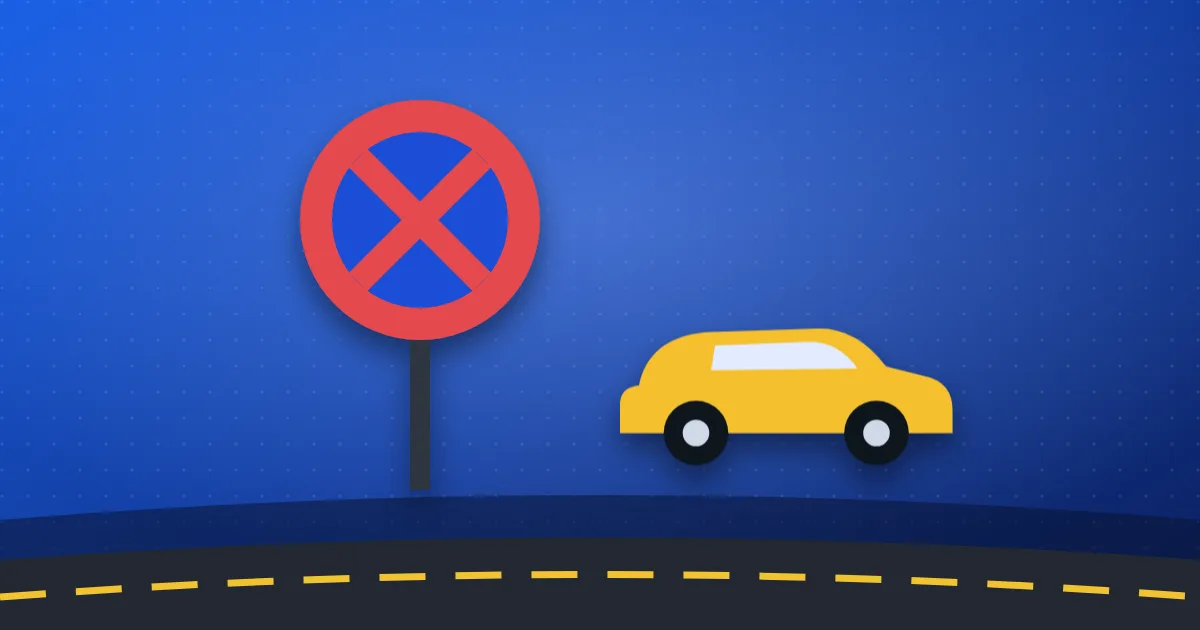
Stopping and parking are different concepts: stopping (duraklama) is a short wait, such as dropping off or picking up people or loading goods, while parking (park etme) is leaving the vehicle other than when halting or stopping is necessary. Parking is banned everywhere stopping is banned, and there are additional banned places and distances for parking.
What Is the Difference Between Stopping and Parking?
Stopping is a short stop, other than for traffic necessities, to drop off or pick up people, load goods or wait; parking is leaving the vehicle.
Article 3 of Highway Traffic Law No. 2918 (Karayolları Trafik Kanunu) separates three concepts. Halting (durma) is stopping the vehicle because of traffic necessities, such as waiting at a red light or because of the vehicle in front. Stopping (duraklama) is a stop, other than for traffic necessities, to drop off or pick up people, load or unload goods, or wait. Parking (park etme) is leaving the vehicle other than when halting and stopping are necessary. So if you walk away from your vehicle, you are generally parking. This difference matters because the banned places for the two concepts are listed in different articles of the law, and the stopping ban also covers the parking ban. In the exam, the question often expects you to mix up these three definitions. On the sign side, you should also learn separately the difference between the no parking sign and the no stopping sign.
Three concepts, three meanings (Law No. 2918, Article 3)
| Concept | Meaning |
|---|---|
| Halting (durma) | Stopping the vehicle because of traffic necessities |
| Stopping (duraklama) | Dropping off or picking up people, loading, unloading or waiting, other than for traffic necessities |
| Parking (park etme) | Leaving the vehicle other than when halting and stopping are necessary |
Where Is Stopping Banned?
Under Article 60 of the law, stopping is banned at pedestrian and school crossings, in the left lane, at junctions, tunnels, bridges and bus stops, and where visibility is poor.
The basis of the ban is Article 60 of Law No. 2918. You may not stop on the carriageway where stopping is banned by a traffic sign. Stopping in the left lane is also banned, except on roads with a rail system. You also cannot stop at pedestrian and school crossings and other crossings, so where there is a pedestrian crossing sign or a school crossing sign you should not even drop off a passenger. Stopping is banned near hill crests or bends where visibility is not sufficient, and at bus, tram and taxi stops. Stopping beside vehicles that are stopped or parked, that is in the second row, is also banned. At junctions, tunnels, ramps, bridges and connecting roads you may not stop within 5 metres inside built-up areas and within 100 metres outside them. Stopping is also banned within 15 metres inside built-up areas and 100 metres outside them on the approach to traffic signs.
- Places where stopping is banned by a traffic sign
- The left lane (except on roads with a rail system)
- Pedestrian and school crossings and other crossings
- Hill crests and bends where visibility is poor
- Bus, tram and taxi stops
- Beside vehicles that are stopped or parked (second row)
Get ready to pass first time
Premium gives you everything you need to walk into the exam confident:
- All of our 1,000+ questions in English, with explanations
- Full mock exams: 50 questions, 45 minutes, just like the real thing
- Practise by subject and focus on your weak spots
- Mistakes notebook, progress chart and no ads
One-time payment: 249.90 TL · valid for 1 year. A resit costs 1,250 TL.
Where Is Parking Banned and What Are the Distances?
Parking is banned everywhere stopping is banned, and distances apply such as 5 metres from a fire hydrant, 15 from a stop sign and 10 from an underpass or bridge.
Article 61 of Law No. 2918 lists the parking bans, and Article 115 of the Highway Traffic Regulation (Karayolları Trafik Yönetmeliği) also has a clear provision on the same subject. First on the list is parking in places where stopping on the carriageway is banned and in places where parking is banned by traffic signs. You also do not park in front of or on access ways. Parking within 5 metres of designated fire hydrants in both directions is banned. You cannot park within 15 metres in both directions of public passenger vehicle stop signs, or within 15 metres of the sign showing the entrance and exit of vehicles with priority of passage. A 5 metre ban applies in both directions at the entrance and exit gates of places used by the public. You also do not park on underpasses, overpasses and bridges or within 10 metres of them. Spaces reserved for vehicles of disabled people and places reserved for certain persons and institutions are also covered by the parking ban.
Distances in the parking bans (Law No. 2918, Article 61)
| Place | Distance |
|---|---|
| Fire hydrants | 5 m in both directions |
| Public passenger vehicle stop signs | 15 m in both directions |
| Entrance-exit sign for vehicles with priority of passage | 15 m |
| Entrance and exit gates of places used by the public | 5 m in both directions |
| Underpasses, overpasses and bridges | On them and within 10 m |
What Happens If I Park in a Banned Place?
A vehicle parked in breach of the bans may be removed by traffic enforcement and is not returned until the costs are paid, and an administrative fine also applies.
Article 61 of the law states that vehicles parked in breach of the bans may be removed by traffic enforcement and will not be handed back until the costs are paid. In the penalty section there is a separate paragraph for each parking violation, so the same wrong parking can be cited under different paragraphs. We do not write the current fine amounts on this page because they change every year with the revaluation; for the most accurate amounts, see our traffic fines page. There is also the penalty points guide on penalty points. For some violations, such as parking in a space reserved for disabled people's vehicles, the sanction is higher. If your vehicle is towed, you cannot collect it without paying the car park and tow truck costs. In short, parking in a banned place, even for a short time, costs both money and time.
- Check the banned place with signs, lines and the distance rules above.
- If you are not sure, park the vehicle somewhere else.
- If your vehicle is towed, you collect it by paying the costs.
- Check the fine and the points against the official amounts.
FAQ
Is a no-parking line valid without a sign?
Yes, no-parking lines are horizontal markings and are drawn on the kerbstones. For lines, see the road markings page.
Is it allowed to drop off a passenger at a pedestrian crossing?
No, stopping is banned at pedestrian and school crossings. You should drop off the passenger at a safe place away from the crossing.
What is second-row parking?
Second row is stopping or parking beside a vehicle that is stopped or parked, on the traffic side of it. Article 60 of the law bans stopping beside vehicles that are stopped or parked.
How do I study the parking rules for the exam?
You can study by solving exam questions. The traffic questions page has traffic and environment tests.
Sources: Highway Traffic Law No. 2918 (Articles 3, 60, 61) · Highway Traffic Regulation (Article 115) · KGM Traffic Penalty Guide (Law No. 2918, Articles 60 and 61 paragraphs). Rules and fees can change; check the official sources for the latest information.