Home / Guides / Rules and fines
Overtaking Rules in Turkey: How and Where to Pass the Vehicle Ahead
Updated 13 November 2026 · 7 min read · testcim editorial team
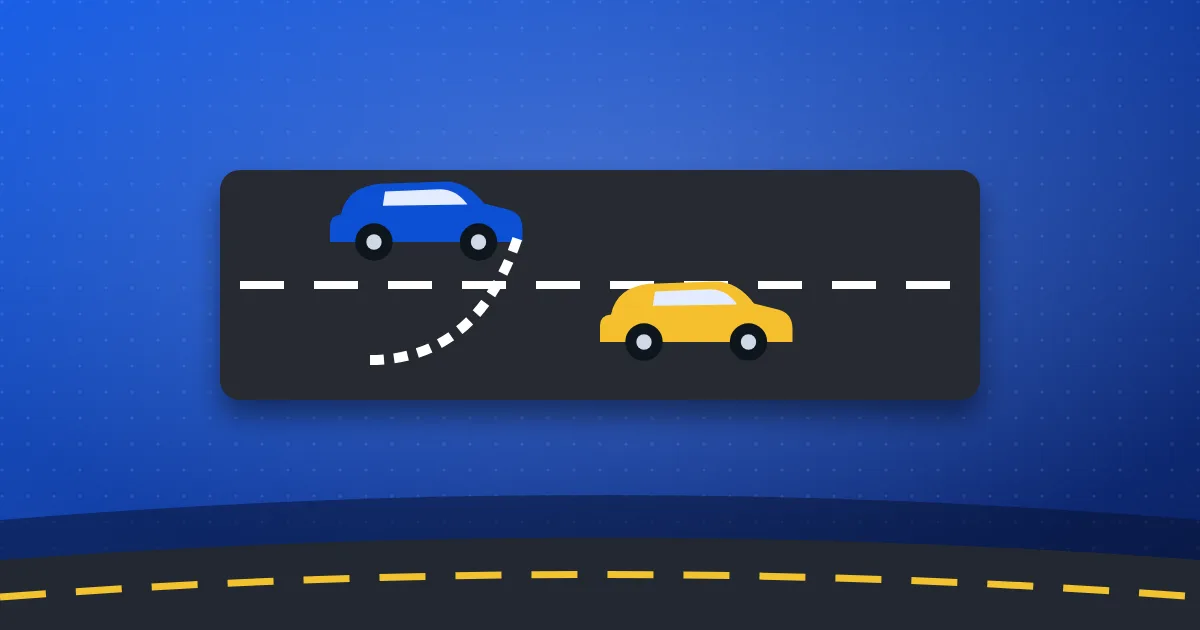
Under the overtaking rules, the vehicle in front is passed on the left: you warn the driver ahead with the horn or headlight flash, signal left, move into the left lane, and when you see the passed vehicle in the mirror you return to your lane with a right signal. Overtaking is banned on hill crests and bends where visibility is poor, at junctions, when approaching level crossings, pedestrian and school crossings, and on single-lane two-way bridges and tunnels.
On Which Side Should I Overtake the Vehicle Ahead?
The vehicle ahead is overtaken on the left; passing on the right or on the verge is allowed only in the few cases listed in the regulation.
Under Article 103 of the Highway Traffic Regulation (Karayolları Trafik Yönetmeliği), overtaking is done in the lane to the left of the vehicle being passed. Passing on the right of vehicles or using the verge is banned. As an exception, you may pass on the right of a vehicle that has signalled a left turn and is slowing down, or one that is waiting because of traffic. Passing on the right of a tram running in the middle of the road, and of a vehicle with priority of passage that is on the left of the road because of its duty, is also allowed. On multi-lane roads reserved for one direction, one lane moving faster than another without changing lanes does not count as overtaking. Before you start to overtake, the vehicle behind must not have started to overtake you, and the vehicle in front must not have signalled that it is overtaking another vehicle. The lane you are going into must also be clear and empty far enough ahead for you to pass without endangering anyone, including oncoming traffic. You can first solve the basic questions in the traffic questions test.
How Do You Overtake Step by Step?
Warn the driver ahead with the horn or lights, signal left, move into the left lane, and return with a right signal once you see the passed vehicle in the mirror.
Article 103 of the Regulation lists in order what the overtaking driver must do. First you warn the driver of the vehicle you will pass with an audible device, or by flashing the dipped and main beam headlights one after the other. Then you signal with the left turn indicator. When you are at following distance from the vehicle you will pass, you settle into the left lane. You continue in the overtaking lane until the vehicle you passed appears in the rear-view mirror. Finally, you signal with the right turn indicator, move into the right lane and complete the overtaking. Turning in too early means cutting in front of the vehicle you have passed. We explain how much gap to leave in the following distance article.
- Warn the vehicle you will pass with the horn or short-long headlight flashes.
- Signal with the left turn indicator.
- Settle into the left lane at following distance.
- Keep going until you see the vehicle you passed in the mirror.
- Signal right and return to the right lane to finish.
Get ready to pass first time
Premium gives you everything you need to walk into the exam confident:
- All of our 1,000+ questions in English, with explanations
- Full mock exams: 50 questions, 45 minutes, just like the real thing
- Practise by subject and focus on your weak spots
- Mistakes notebook, progress chart and no ads
One-time payment: 249.90 TL · valid for 1 year. A resit costs 1,250 TL.
Where Is Overtaking Banned?
Overtaking is banned where there is an overtaking ban sign, on hill crests and bends with poor visibility, when approaching pedestrian and school crossings, junctions and level crossings, and on single-lane two-way bridges and tunnels.
Article 104 of the Regulation lists the places where overtaking is banned under five headings. The first is places where overtaking is banned by a traffic sign; besides signs, a solid line on the road is also among the signs that ban overtaking. The second is hill crests and bends where visibility is poor. You also do not overtake when approaching pedestrian and school crossings. Overtaking is banned at junctions and level crossings and when approaching them. On two-way bridges and tunnels with one lane for each direction, you cannot pass the vehicle in front either. For details of the overtaking ban sign, look at the no overtaking sign page and the end of no overtaking sign page that shows the ban is over. We explain road lines separately in the road markings article.
- Places where overtaking is banned by a traffic sign (sign, solid line)
- Hill crests and bends where visibility is poor
- When approaching pedestrian and school crossings
- Junctions, level crossings and when approaching them
- Two-way bridges and tunnels with one lane for each direction
What Should the Driver Being Overtaken Do?
The driver being overtaken does not speed up and, on a two-way road, keeps near the right edge; on a narrow or busy road he pulls right, slows down and stops if necessary.
Article 105 of the Regulation sets the rules for the driver being overtaken. A driver who receives an audible or light signal for overtaking keeps close to the right edge of the carriageway on a two-way road and does not increase speed. On roads with more than four lanes or on divided roads, he follows the lane he is in. On narrow and busy roads, a driver who is holding up vehicles behind because he is slow moves as far to the right as he can, slows down and stops if necessary. The same article bans refusing to give way to someone who wants to overtake, and bans the vehicle being overtaken from itself attempting to overtake another vehicle or turn left. The rules for meeting an oncoming vehicle in a narrow place are in Article 106. If the driver being overtaken speeds up, he endangers the overtaker, so obeying the rules on both sides keeps everyone safe together. The MEB programme also makes the behaviour of the driver being overtaken a separately measured learning outcome.
Duties of the overtaking and the overtaken driver
| Driver | What do they do? |
|---|---|
| Overtaking | Warns, signals left, moves into the left lane at following distance, returns with a right signal when the vehicle is seen in the mirror |
| Overtaken | Does not increase speed, keeps near the right edge; on a narrow road moves right, slows down, stops if necessary |
What Happens If I Do Not Follow the Overtaking Rules?
Not following the overtaking rules and overtaking where it is banned are counted as separate violations in paragraph 1 of Article 54 of Law No. 2918.
According to the EGM penalty guide, paragraph 54/1-a covers not following the overtaking rules when overtaking the vehicle ahead. Paragraph 54/1-b covers overtaking the vehicle ahead in places where overtaking is banned. We have not put figures here, because the amount of the fine changes with the annual revaluation. For current amounts, look at the traffic fines page, and for penalty points, the penalty points article. The real risk is the possibility of a collision with oncoming traffic. As a driver, refresh your knowledge of signs and lines so that you can quickly recognise banned places in the exam and in traffic. You can open the Highway Traffic Law page for the detailed text of the rule. You can also find the subject of stopping and parking in the stopping and parking rules article.
Overtaking violations in the law (EGM guide)
| Paragraph | Violation |
|---|---|
| 54/1-a | Not following the overtaking rules when overtaking the vehicle ahead |
| 54/1-b | Overtaking the vehicle ahead in places where overtaking is banned |
FAQ
On which side is overtaking done?
You overtake the vehicle ahead on the left. Passing on the right is allowed only in cases listed in the regulation, such as a vehicle waiting or slowing down to turn left.
Can you overtake on a solid line?
No, overtaking is banned where there is a solid, that is unbroken, road line. You can find the types of lines in the road markings article.
Is overtaking banned at a junction?
Yes, overtaking is banned at junctions and when approaching them. The same ban applies when approaching level crossings and pedestrian and school crossings.
Can you overtake on bridges and tunnels?
Overtaking is banned on two-way bridges and tunnels with one lane for each direction.
Sources: Highway Traffic Law No. 2918 (mevzuat.gov.tr) · Highway Traffic Regulation (mevzuat.gov.tr) · EGM Traffic Administrative Fines Guide · MEB Traffic and Environment Lesson Programme. Rules and fees can change; check the official sources for the latest information.