Home / Guides / Rules and fines
Traffic Police Hand Signals in Turkey and Their Meanings
Updated 13 November 2026 · 7 min read · testcim editorial team
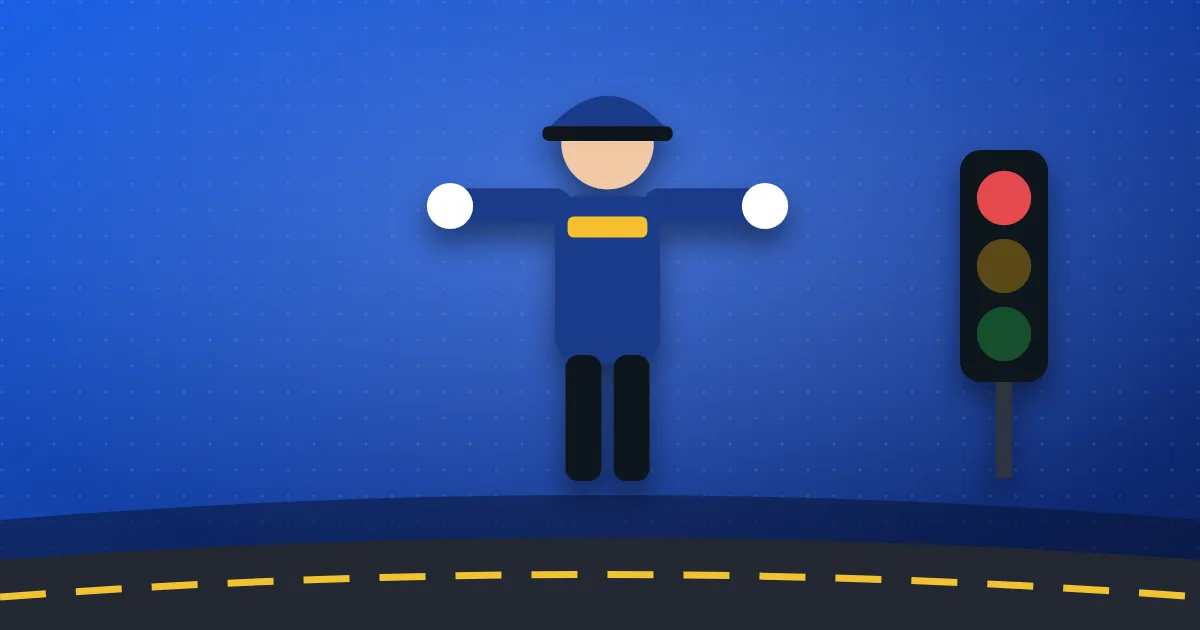
Traffic police hand signals take priority over light signals and road signs; if the officer says stop, you stop even when the light is green. If the officer raises one arm upright it means stop for everyone, and if the arms are stretched out to the sides it means stop for traffic from the front and back and go for traffic in the direction of the arms.
Do I Have to Obey Traffic Police Hand Signals?
Yes, drivers must obey the signals and instructions of the traffic officer, and not obeying them is counted as a violation under the Highway Traffic Law.
Article 47 of Highway Traffic Law No. 2918 (Karayolları Trafik Kanunu) is titled "Obligation to obey traffic signs and rules". In the traffic administrative fines guide of the General Directorate of Security (EGM), not obeying the warnings and signals of traffic enforcement and authorised persons appears as a separate violation. The driving course programme of the Ministry of National Education (MEB) teaches this subject under the heading "Traffic Officers' Movements for Directing Traffic", in a unit of two theory hours. The learning outcome in the programme asks you to explain the officer's authority to intervene in traffic and the driver's obligation to follow instructions. Knowing the meaning of the hand signals of police and municipal officers is also part of the same outcome. According to the programme, the obligation to follow the officer's instructions is one of the basic duties of a driver. To reinforce the subject, you can take the traffic questions test.
Which Comes First: Officer, Light or Sign?
Under the regulation, the officer's signal comes first, then light and sound signals, then signs and road markings, and finally the other traffic rules.
This order is written in Article 95 of the Highway Traffic Regulation (Karayolları Trafik Yönetmeliği), and the last sentence of the article says that priority in obeying follows this order. For example, if the light is green and the officer gives you a stop signal, you stop. If a light and a sign conflict, you obey the light, because light signals come before signs. Signs, arrangements and the lines on the ground are on the same level; we explain the meanings of road lines in the road markings article. The general rules written in the law and the regulation are at the very end of the order. This order is asked often in the exam, because in real traffic officers frequently work at junctions where the lights are not working. To see the order of passage at a junction, you can look at the right of way at junctions article.
- Warnings and signals of officers
- Light and sound traffic signals
- Traffic signs, their arrangements and markings on the ground
- Other rules in the law and the regulation
Get ready to pass first time
Premium gives you everything you need to walk into the exam confident:
- All of our 1,000+ questions in English, with explanations
- Full mock exams: 50 questions, 45 minutes, just like the real thing
- Practise by subject and focus on your weak spots
- Mistakes notebook, progress chart and no ads
One-time payment: 249.90 TL · valid for 1 year. A resit costs 1,250 TL.
What Do the Traffic Officer's Hand and Arm Signals Mean?
An arm held straight up means stop for everyone; arms stretched to the sides mean stop for traffic in front of and behind the officer and go for traffic in the direction of the arms.
Under Article 96 of the Regulation, an officer raising one arm straight up is a STOP order for everyone using the road. This order has two exceptions: drivers who are so close that they cannot stop safely, and drivers who have entered the junction or are inside it. For this reason, in courses this signal is often compared to a yellow light. If the officer extends the arm or arms horizontally to the sides, those coming from the directions that cross the line of the arms, that is, from the front and back of the officer, stop. Those coming from the direction in which the arms point may proceed. After giving the signal, the officer may lower the arms; lowering the arms does not change the order given. Swinging a red light by the officer is also a STOP order for those in the direction the light is pointed. To be ready for the images that come up in the exam, also study the road signs page.
The officer's signal and its equivalent
| Officer's movement | Meaning |
|---|---|
| One arm straight up | STOP for everyone (except those who have entered the junction and cannot stop safely) |
| Arm or arms horizontal to the sides, front and back | STOP |
| Arm or arms horizontal to the sides, direction of the arms | You may proceed |
| One arm up, the other down | Attention: the direction is changing, the open road will close, the closed road will open |
| Swings a red light | STOP for the direction the light is pointed |
How Are the Slow-Down and Speed-Up Signals Given?
To slow traffic the officer faces it and slowly swings an arm held parallel to the ground; to speed it up the officer stands side-on and moves the elbow-bent arm up and down.
Under Article 25 of the Regulation, to slow traffic down, the officer stands facing the direction to be slowed. The officer raises an arm from the shoulder parallel to the ground and slowly swings it between 45 and 90 degrees. To speed traffic up, the officer stands side-on to the direction to be speeded up. Bending the arm, held parallel to the ground, at the elbow, the officer raises and lowers the part up to the hand. Repeating this movement in quick succession is an instruction for traffic in that direction to speed up. To avoid confusing the two signals, keep the difference in mind. In the slow-down signal the arm swings slowly and widely, while in speed-up the arm is bent at the elbow and moves up and down quickly. In real traffic, pay attention to the direction the officer faces, because the signal is valid only for the direction the officer is facing.
- Slow down: facing you, arm parallel to the ground, swung slowly 45-90 degrees.
- Speed up: side-on, arm bent at the elbow moves up and down in quick succession.
- The signal is valid for the direction the officer is facing.
What Do the Traffic Officer's Whistle Sounds Mean?
A short single or intermittent whistle is a warning, and a long single or intermittent whistle is a STOP order.
Article 96 of the Regulation defines the whistle as an aid to the officer's arm movements. A short whistle warns you; look at the officer and obey the arm signal given. A long whistle means stop directly. The same article also sets rules for officers: at junctions with traffic lights they do not interfere with the control unless necessary. They also take care not to stop vehicles that are moving on a green light or about to enter the junction with sudden signals. As a driver, do not move off without being sure that the officer has seen you, and slow down if in doubt. You can find the penalty for not obeying the officer's signals on the traffic fines page, and the penalty points on the penalty points page. For the full text of the articles, you can look at the Highway Traffic Regulation page.
Whistle sounds
| Sound | Meaning |
|---|---|
| Short, single or intermittent | Warning |
| Long, single or intermittent | STOP |
FAQ
Which is valid, the traffic officer or the light?
The traffic officer's signal is valid. The officer comes before the light signal and the sign.
What does it mean if the traffic officer raises an arm?
Raising one arm straight up is a stop order for everyone. Those who have entered the junction and those who are too close to stop safely continue and clear the junction.
What happens if I do not obey the officer's signal?
Not obeying the signal and instructions of traffic enforcement appears as a separate violation in the EGM penalty guide. For the current amount, see the traffic fines page.
Does the order end if the officer lowers the arms?
No, the officer lowering the arms does not change the order given earlier. The earlier order is valid until a new signal is given.
Sources: Highway Traffic Law No. 2918 (mevzuat.gov.tr) · Highway Traffic Regulation (mevzuat.gov.tr) · EGM Traffic Administrative Fines Guide · MEB Traffic and Environment Lesson Programme. Rules and fees can change; check the official sources for the latest information.