Home / Guides / Rules and fines
Right of Way at Junctions in Turkey: Who Goes First, Who Yields?
Updated 13 November 2026 · 8 min read · testcim editorial team
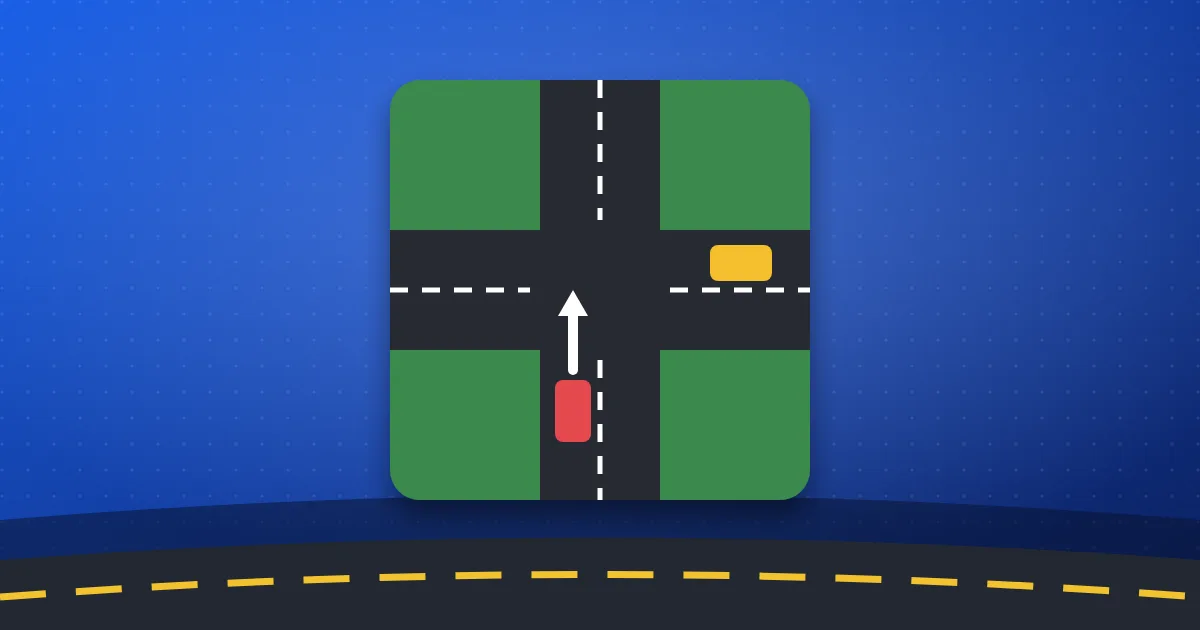
Right of way at junctions belongs first to the side shown by the officer, the light and the sign; if there are none, an emergency vehicle with priority of passage, a tram, a vehicle on the main road and a vehicle already inside a roundabout go first. If there is no difference between the arms, the driver on the left gives way to the driver coming from the right.
Who Has the Right of Way at Junctions in Turkey?
The officer, light and sign decide first; otherwise priority vehicles, trams, the main road and the roundabout interior go first, and the give-way-to-the-right rule applies last.
The Highway Traffic Regulation (Karayolları Trafik Yönetmeliği) defines right of way as the priority that pedestrians and drivers have over others when using the road. Article 109 of the Regulation lists one by one who gives way to whom at junctions without an officer, sign or light. In this order, drivers first give way to vehicles with priority of passage, then to trams that are passing correctly. A driver entering a divided road, or entering a main road from a minor road, gives way to the vehicles on that road. A driver arriving at a roundabout gives way to those already in the junction, and a driver coming out of a property or a dirt road gives way to those on the highway. A driver making a turn also gives right of way to vehicles that are passing correctly. Every driver approaching a junction must also slow down, be careful and let the one with the right of way pass first. Not obeying this rule is counted as a violation under Article 57 of Highway Traffic Law No. 2918 (Karayolları Trafik Kanunu).
Who yields to whom at a junction with no officer, light or sign? (Regulation, Article 109)
| Who yields | To whom |
|---|---|
| All drivers | Vehicles with priority of passage |
| All drivers | A tram passing correctly |
| A driver entering a divided road | Vehicles passing on that road |
| A driver entering a main road from a minor road | Vehicles on the main road |
| A driver arriving at a roundabout | Vehicles inside the roundabout |
| A driver leaving a property or a dirt road | Vehicles on the highway |
| A driver making a turn | Vehicles passing correctly |
| If there is no difference between the arms, the vehicle on the left | The vehicle coming from the right |
Who Goes First at an Uncontrolled Junction?
If there is no distinction between main and minor road, no light and no officer, the driver of the vehicle on the left gives way to the vehicle coming from the right.
An uncontrolled junction is one where passage is not regulated by a light or an officer. Paragraph (c) of Article 109 of the Regulation says that, unless there is a sign showing that the arms of the junction differ in traffic density, the vehicle on the left must give way to the vehicle on the right. The criterion is not the size of the street, but which direction the vehicle is coming from. The same paragraph also includes that drivers of non-motorised vehicles give way to motor vehicles. Drivers of rubber-wheeled tractors, off-road vehicles and construction machines also give way to other motor vehicles. If you are going to turn, you also give way to pedestrians crossing in accordance with the rules and, where there is one, to cyclists on the cycle path. For the sign page for this sign, you can look at the crossroads sign article. The penalties for junction rules are listed with their current amounts on the traffic fines page.
- The vehicle on the left gives way to the one coming from the right.
- A non-motorised vehicle gives way to a motor vehicle.
- Tractors, off-road vehicles and construction machines give way to other motor vehicles.
- A turning vehicle gives way to pedestrians and to cyclists on the cycle path.
Get ready to pass first time
Premium gives you everything you need to walk into the exam confident:
- All of our 1,000+ questions in English, with explanations
- Full mock exams: 50 questions, 45 minutes, just like the real thing
- Practise by subject and focus on your weak spots
- Mistakes notebook, progress chart and no ads
One-time payment: 249.90 TL · valid for 1 year. A resit costs 1,250 TL.
Who Has the Right of Way at a Main Road and Minor Road Junction?
At a main road and minor road junction, the driver coming from the minor road must give first right of way to vehicles on the main road.
According to the Regulation, a main road is a highway on which signs have established that traffic on the crossing roads must give first right of way. In other words, it is the sign that determines the main road. Under Article 109 of the Regulation, a driver entering a divided road or a road with a tram line also gives way to the vehicles on that road. If you are on the minor road, you will often meet the give way sign, and at some junctions there is a stop sign. At a stop sign you must come to a full stop and then wait for those who have the right of way. Even a driver on the main road should reduce speed according to conditions when approaching a junction. For the sign of this junction, see the junction with minor road sign and the priority road sign that shows you are on the main road.
- Slow down as you approach the junction.
- Check from the sign whether you are on the main road or the minor road.
- If you are on the minor road, give way to vehicles on the main road.
- If there is a stop sign, stop completely, then go.
Who Gives Way to Whom at a Roundabout?
A driver about to enter a roundabout gives way to vehicles already inside it; the vehicle circulating inside has priority.
The MEB driving course programme divides junctions into controlled, uncontrolled, classic roundabout and modern roundabout. At a roundabout the rule is short: the vehicle circulating inside has the right of way, and the one who wants to enter waits. You need to reduce speed when entering the junction and show your direction with a signal inside the junction. According to the Regulation, even if the light allows it, you are forbidden to enter a junction if traffic will force you to stop inside it. This rule prevents the junction from locking up. When leaving the junction, if you move to the right lane and signal, the driver behind you understands your intention. To see the roundabout sign in detail, the roundabout sign page will help you.
What Is the Difference Between Right of Way and Priority of Passage?
Right of way is the priority every road user has over others when using the road, while priority of passage is the special priority given to certain vehicles in an emergency.
The Regulation defines these two concepts separately. Right of way is the ordinary traffic rule that determines who passes first in places such as junctions, crossings and narrow roads. Priority of passage, on the other hand, means that certain vehicles on duty are not bound by traffic restrictions and prohibitions, provided they do not endanger life and property. Ambulances, fire engines and police vehicles are the best-known examples, and they use this priority only while on duty. Under Article 142 of the Regulation, when you receive the audible or light signal of such a vehicle you make room and, if necessary, stop. If you are inside a junction, you must clear the junction immediately. Not giving way to vehicles with priority of passage is among the violations in Article 57 of the Law. You can find the current amounts of the penalties and the points on the penalty points and traffic fines pages. You can reinforce junction questions with the traffic questions test.
Right of way and priority of passage
| Concept | Meaning |
|---|---|
| Right of way | The priority of pedestrians and drivers over others when using the road |
| Priority of passage | Certain vehicles on duty (such as ambulances, fire engines and police) not being bound by traffic restrictions, without endangering safety |
FAQ
Does the vehicle coming from the right go first at a junction?
Yes, if there is no light, officer or sign, and the traffic density of the junction arms is not distinguished by a sign, the vehicle on the left gives way to the one coming from the right. If there is a vehicle from the main road, a tram or a vehicle with priority of passage, they go earlier.
If the light is green, can I always enter the junction?
No, even if the light allows it, you are forbidden to enter the junction if traffic will force you to stop inside it. Wait for space to open up on the other side.
Whom do you obey if there is a traffic officer at the junction?
You obey the traffic officer's signal first, then the light, then the sign. We explain the officer's signals in the traffic police hand signals article.
Is it compulsory to reduce speed when approaching a junction?
Yes, when approaching junctions you must slow down in line with the conditions at the junction. Not slowing down is one of the violations in Article 57 of the Law.
Sources: Highway Traffic Law No. 2918 (mevzuat.gov.tr) · Highway Traffic Regulation (mevzuat.gov.tr) · EGM Traffic Administrative Fines Guide · MEB Traffic and Environment Lesson Programme. Rules and fees can change; check the official sources for the latest information.