Home / Practice test / Free 50-question mock exam 2
Turkish driving test practice: 50 questions in English (Test 2)
Last updated: 28 October 2026 · Free, no sign-up
This mock exam has the same structure as the real Turkish driving licence e-exam: 50 questions, 45 minutes and a pass mark of 70 (at least 35 correct). The questions follow the real subject split: 23 Traffic and Environment, 12 First Aid, 9 Vehicle Technology, 6 Traffic Etiquette. Choose your answers, then press Finish exam at the bottom to see your score, your result in each subject and the correct answers.
Tests · 50 questions each
Question 1 · First Aid
The airway of an unresponsive adult is opened. The person takes irregular, inadequate gasps at long intervals, like sighs. What should the first aider do?
Show answer and explanation
Correct answer: D) Treat it as absent normal breathing and start basic life support
Occasional, sigh-like irregular gasps (agonal breathing) are not normal breathing and are an early sign of cardiac arrest; basic life support is started at once (ERC 2021). The recovery position is only for an unconscious person who is breathing normally; waiting leads to brain damage.
Question 2 · Traffic and Environment

When should the driver of vehicle no. 1, overtaking truck no. 2 in the picture, return to the right lane?
Show answer and explanation
Correct answer: B) After seeing the truck in the interior rear-view mirror, signalling right
An overtaking driver stays in the left lane until the overtaken vehicle can be seen in the interior rear-view mirror, then signals right and returns to the right lane (Art. 103). Returning early cuts off the overtaken vehicle; staying in the left lane needlessly endangers oncoming traffic.
Question 3 · Vehicle Technology
What is the job of the valves in an engine?
Show answer and explanation
Correct answer: B) To control what enters the combustion chamber and let exhaust gases out
The intake valve controls the entry of the mixture (air in a diesel), and the exhaust valve lets burnt gases out.
Question 4 · Traffic and Environment
What does the catalytic converter in the exhaust system do?
Show answer and explanation
Correct answer: D) Turning harmful exhaust gases into less harmful ones
The catalytic converter uses chemical reactions to turn carbon monoxide, unburned hydrocarbons and nitrogen oxides into less harmful substances such as carbon dioxide, water vapour and nitrogen. The silencer reduces noise; the air filter cleans intake air.
Question 5 · First Aid
What is done in first aid for a scorpion sting?
Show answer and explanation
Correct answer: D) Wash the area, apply cold for about 15 minutes and keep it still
Calm the person, wash the area with soap and water, apply cold for 15 minutes, put on a bandage that does not stop circulation and keep the area still. Cutting and sucking are harmful; call 112.
Question 6 · Traffic and Environment
At the junction shown, roads of equal importance cross and there are no lights, signs or officers. Which vehicle goes first?
Show answer and explanation
Correct answer: B) Vehicle 2
At uncontrolled junctions of equal roads, give way to the vehicle coming from the right. For vehicle 1, vehicle 2 is coming from the right.
Question 7 · First Aid
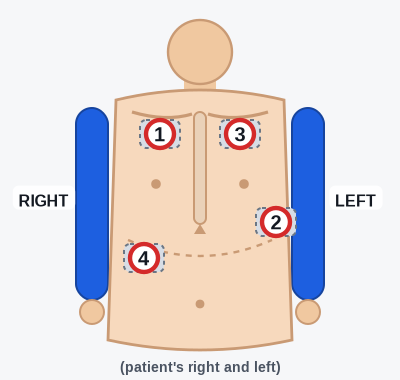
In the figure, where should the pads be placed when using an AED on an adult?
Show answer and explanation
Correct answer: A) 1 and 2
One pad goes below the patient's right collarbone, to the right of the breastbone; the other to the left of the left nipple, on the side above the lower ribs (1 and 2). This way the current passes diagonally through the heart; the pads must not touch each other.
Question 8 · Vehicle Technology
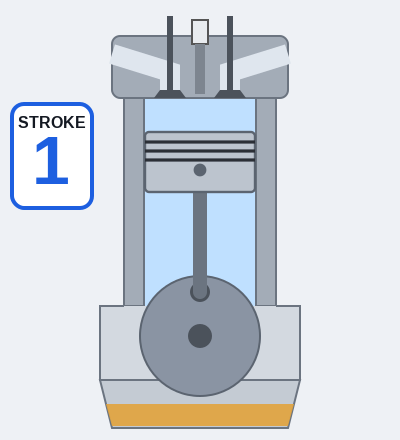
The animation shows one cycle of a four-stroke engine as strokes 1, 2, 3 and 4 in order. In which stroke does the burning mixture push the piston down and deliver power to the crankshaft?
Show answer and explanation
Correct answer: C) Stroke 3
The four strokes are intake (1), compression (2), power/combustion (3) and exhaust (4). When the compressed mixture ignites, the expanding gases push the piston down; this is the only stroke that produces power. In the other three strokes the piston is moved by energy stored in the flywheel.
Question 9 · Traffic Etiquette
In traffic, the 'principle of trust' means that a law-abiding driver may act on the assumption that other road users will also obey the rules. In which of the following situations would relying on this principle be most wrong?
Show answer and explanation
Correct answer: A) Assuming that children chasing each other on the pavement will not run into the road
The principle of trust applies only as long as the other person can be expected to behave correctly. It cannot be relied on with people who clearly may not follow the rules, such as children, distracted pedestrians and the elderly; the driver must slow down and be ready to stop.
Question 10 · Traffic Etiquette
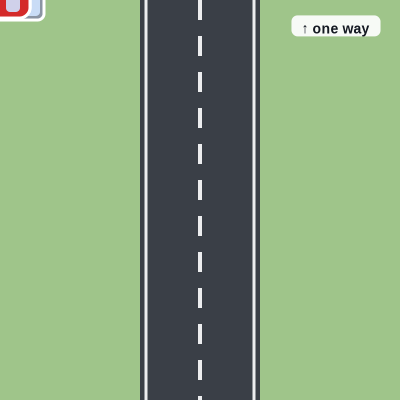
In the picture, on a one-way road, green car no. 2 is overtaking lorry no. 3 in the left lane. Red car no. 1 comes right up behind no. 2 and flashes its headlights repeatedly. Which statement about car no. 1 is correct?
Show answer and explanation
Correct answer: A) It is putting pressure on a driver trying to complete an overtake, creating danger
Car no. 2 must finish overtaking and then return to the right lane; tailgating and repeated flashing put it under stress and raise the risk of mistakes and a crash. Flashing is for a brief warning, not a means of harassment; car no. 1 should keep a safe distance and wait for no. 2 to move back.
Question 11 · Traffic and Environment
What does the traffic sign shown mean?
Show answer and explanation
Correct answer: B) One-way road
An arrow in a blue square or rectangle is an information sign meaning the road is one-way in the direction of the arrow. A blue circle would be a mandatory sign.
Question 12 · First Aid
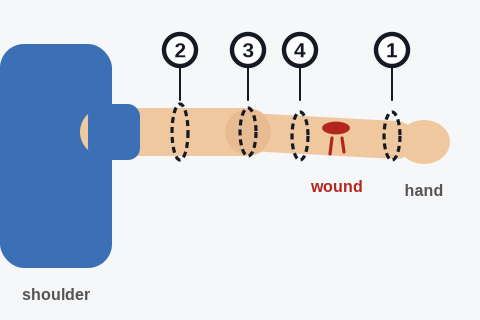
The casualty in the figure has blood spurting from a wound on the forearm, and direct pressure and a pressure bandage cannot stop it. At which numbered location should the tourniquet be applied?
Show answer and explanation
Correct answer: B) 2
In the Turkish Ministry of Health curriculum a tourniquet goes on the nearest single-bone segment with intact skin above the bleeding (upper arm or thigh), so the correct place is the upper arm (2). It is never placed over a joint (3), and the two-bone forearm and wrist (4, 1) are used only in amputations. ERC guidance places it a few centimetres above the wound, but the Turkish curriculum is followed here.
Question 13 · First Aid
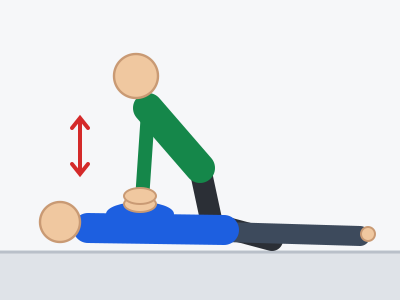
While giving chest compressions to an adult as shown, what should be done after each compression?
Show answer and explanation
Correct answer: B) Let the chest return fully to its normal position
After each compression the chest is allowed to recoil fully; this lets the heart refill with blood. The hands are not lifted or moved, there is no pulse check between compressions and pauses must not exceed 10 seconds (MoH Skills Guide).
Question 14 · Traffic and Environment
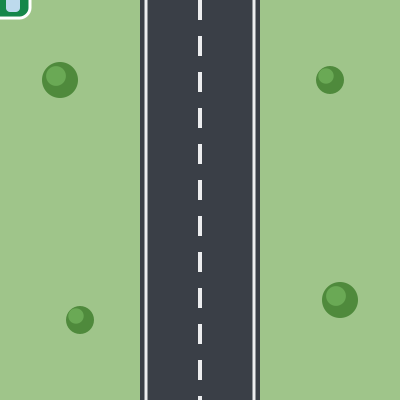
On a road with a continuous (solid) centre line like the one shown, what is prohibited?
Show answer and explanation
Correct answer: B) Crossing the line to overtake
A solid centre line must not be crossed or touched, so you cannot move into the opposite lane to overtake there.
Question 15 · Vehicle Technology
What is the minimum winter tyre tread depth for lorries and buses?
Show answer and explanation
Correct answer: C) 4 mm
Under the Winter Tyre Communiqué, winter tyres on lorries, tractor units and buses must have at least 4 mm of tread. For cars, minibuses and vans the minimum is 1.6 mm.
Question 16 · Traffic Etiquette
In the picture, green car no. 1 is weaving within its lane. The driver notices that they keep yawning and cannot remember the last few kilometres. What is the most appropriate behaviour?
Show answer and explanation
Correct answer: D) Stop at the first safe rest area and sleep or rest
Weaving, frequent yawning and not remembering the last kilometres are signs of serious fatigue and microsleep. Coffee, fresh air or loud music only help briefly; the driver must stop at the first safe place and rest or sleep.
Question 17 · Traffic and Environment
What is the speed limit for cars on a dual carriageway (divided road) in Turkey?
Show answer and explanation
Correct answer: C) 110
The maximum speed for cars on divided roads is 110 km/h.
Question 18 · First Aid
Two first aiders are giving basic life support together to a 5-year-old child who is not breathing. According to first aid training in Türkiye, what should the compression-to-breath ratio be?
Show answer and explanation
Correct answer: B) 15 compressions / 2 breaths
According to the MoH Skills Guide, for children and infants a single first aider uses 30:2 and two or more first aiders use 15:2. ERC guidelines also recommend 15:2 for trained rescuers in children; the exam follows this distinction in the Turkish curriculum.
Question 19 · Traffic and Environment
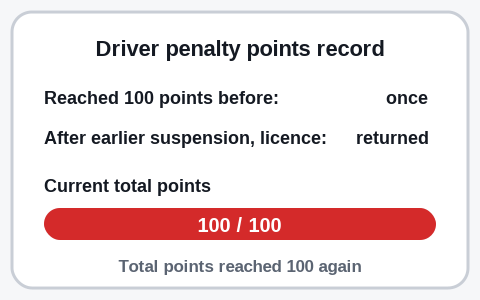
Based on the record shown, what action is taken regarding this driver's licence?
Show answer and explanation
Correct answer: B) It is suspended for 4 months; the driver undergoes a psycho-technical assessment and a psychiatric examination
The driver has reached 100 points once before and now reaches it a second time. The second time, the licence is suspended for 4 months and the driver undergoes a psycho-technical assessment and psychiatric examination; if fit, the licence is returned afterwards (Traffic Law Art. 118). 2 months applies the first time and cancellation the third time.
Question 20 · Traffic and Environment
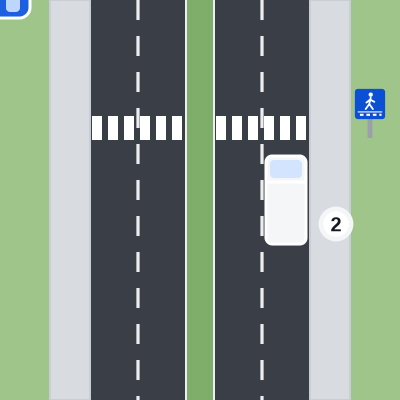
In the picture, lorry 2 in the right lane has stopped in front of a marked pedestrian crossing. What should the driver of car 1, travelling in the left lane in the same direction, do?
Show answer and explanation
Correct answer: B) Slow down and be ready to stop at the crossing
At a crossing without signals, pedestrians who are crossing or about to cross have priority (Traffic Law Art. 74). A large vehicle stopped in the next lane may be hiding a pedestrian in front of it. A defensive driver slows down, is ready to stop and lets the pedestrian cross safely.
From question 21, the questions are Premium. The first 20 questions are free. To see the other 30 questions, finish the exam and get your score, you need Premium. If you are a Premium member, log in and the questions will open here.
A different 50-question mock exam every time
The questions on this page are free samples. Premium unlocks over 1,000 questions in English with explanations, a different 50-question mock exam every time, practice by subject and a mistakes notebook.
One-time payment: 249,90 TL · valid for 1 year.
Before the exam
For exam day, the appointment and results, read the e-exam day guide, when the driving test is and how to check your result. Then practise your weakest subject: traffic, first aid, vehicle technology, traffic etiquette.
Frequently asked questions
How many questions are in the Turkish driving theory test and how long is it?
The e-exam has 50 multiple-choice questions and you have 45 minutes. Candidates with a hearing impairment get 15 extra minutes.
What is the pass mark?
You need 70 out of 100. The score is the number of correct answers divided by the number of questions, times 100, so you need at least 35 correct answers out of 50.
How are the 50 questions split between subjects?
23 Traffic and Environment, 12 First Aid, 9 Engine and Vehicle Technology and 6 Traffic Etiquette.
Do wrong answers lose points?
No. Only correct answers count, so never leave a question blank.
Source: MEB MTSK e-Exam Guide 2026 (number of questions, time, pass mark and subject split). The question pool contains past exam questions published by MEB and original questions written to the MEB curriculum, translated into English.